





Côtes-du-Rhône-Villages Vieilles Vignes Font de Courtedune 2021
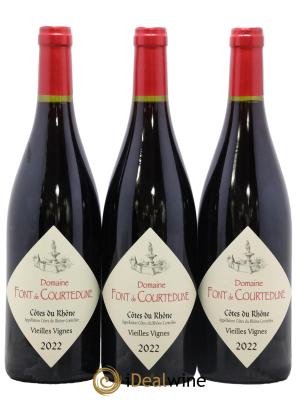
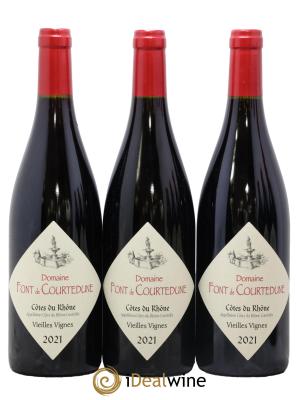
Information
Established in 1997 by the Charrier family when they decided to leave the winemaking cooperative and vinify independently, the estate has steadily built a reputation as one of the appellation’s respected and consistent producers. Today, Caroline Charrier oversees winemaking, while her brother Frédéric manages the vineyards, continuing a family venture that may, in time, be passed on to the next generation.
The vineyard extends over around 35 hectares across several appellations. Grenache forms the backbone of the plantings, alongside Syrah, Cinsault and Mourvèdre, with smaller proportions of lesser-known varieties such as Caladoc. The soils, composed of nearly 80% sand, recall those of certain neighbouring terroirs – notably Château Rayas – and naturally lend themselves to wines of great refinement and delicacy.
Vineyard management is conventional and pragmatic, with regular soil cultivation and sheep manure used as fertiliser. Harvesting is adapted to grape variety and training system: trellised Syrah parcels are machine-harvested, while the old Grenache vines trained using the gobelet method (forming four arms around a central base to distribute and aerate the clusters) are picked by hand.
In the winery, long macerations with whole bunches and ageing in concrete vats – up to two years for the Châteauneuf-du-Pape – are designed to preserve freshness and aromatic purity. The wines stand out for their expressive fruit, balance and elegance, qualities regularly praised by specialist guides such as La Revue du Vin de France.
This cuvée draws its richness from old vines over 60 years of age, rooted deep in the stony soils of Courthézon on the Châteauneuf-du-Pape plain. The terroir is dominated by rolled pebbles, silty-clayey sands and alluvial terraces. These well-drained soils absorb heat by day and release it by night, encouraging optimal ripening of the berries.
Harvesting is carried out by hand at full maturity, with rigorous sorting in the vineyard to retain only the healthiest and ripest berries. Fermentation follows traditional methods in concrete vats with native yeasts, and a long three-week maceration period. Ageing then continues for 12 months in concrete vats and old foudres (large wooden tuns), with no new oak.
The wine exhibits a beautiful deep ruby-red hue. The nose is expressive and complex, unfolding aromas of black cherry, blackberry, plum, garrigue and violet. On the palate, the wine is ample, generous and well-balanced.
Price estimate for wine from the same producer
- Region:
- Rhone Valley
- Producers and wineries:
- Font de Courtedune
- Colour:
- red
- Food and wine pairings:
- Tajine d’agneau aux pruneaux, Daube provençale aux olives, Magret de canard rôti, purée de panais
- Appellation:
- Côtes-du-Rhône-Villages
- Owner:
- Font de Courtedune
- Viticulture:
- environmentally friendly More information....
- Service temperature:
- 16°
to statistics for over 150,000 price estimates